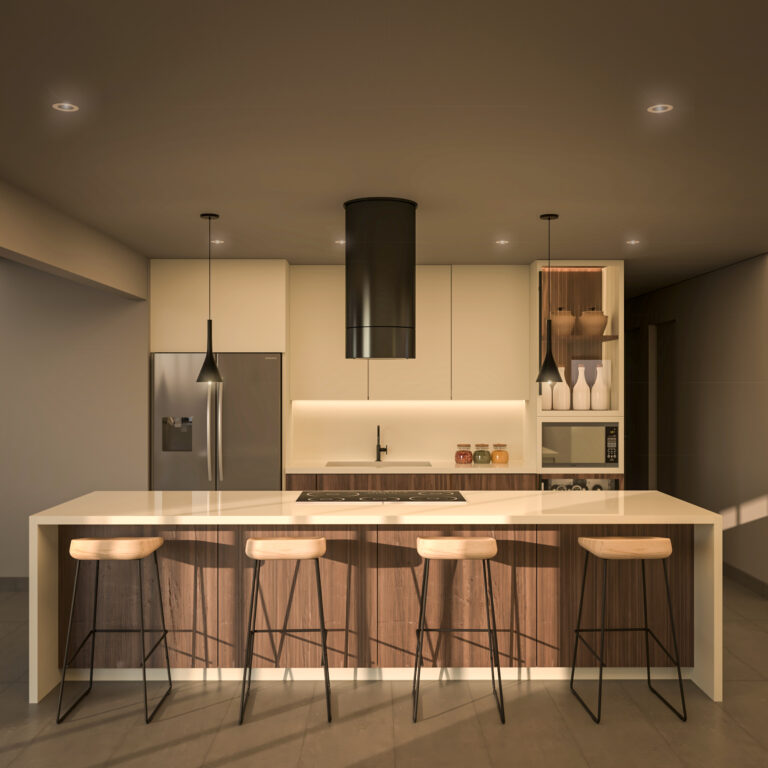
Wood Paneling for Miami Homes: Fluted, Slatted and Custom Millwork Walls Built for the Climate
How wood paneling performs in Miami humidity: fluted vs slatted walls, the best woods and finishes, and the details that keep custom millwork stable.

In this article
- Does wood paneling work in Miami humidity?
- Fluted, slatted or flat: which wall paneling suits the room?
- Which woods and materials perform best in Miami?
- What finish protects wood paneling in a humid climate?
- Detailing and installation that keep paneling stable
- Wall paneling ideas for Miami interiors
- How Pambuddha Homes designs a paneled wall
- Frequently asked questions
Wood paneling works in Miami when it is designed for the climate rather than bought for the look. Real wood is hygroscopic: it takes on and releases moisture with the air around it. In a city where outdoor humidity stays high for most of the year, a paneled wall stays calm only when the species, the construction, the finish and the installation are chosen together, and when the room itself holds steady humidity.
At Pambuddha Homes, the studio led by founder and creative director Pam Sarmiento and architect and partner Melissa Sierra, we treat a paneled wall as architecture, not decoration. This guide covers what we weigh before a single flute is cut.
We treat a paneled wall as architecture, not decoration.
From the studio
DOES WOOD PANELING WORK IN MIAMI HUMIDITY?

Yes, provided it is engineered and detailed for humidity. Problems such as cupping, open joints, swelling and mold come from moisture imbalance, not from wood itself.
HOW WOOD RESPONDS TO THE AIR
Wood settles at an equilibrium moisture content that follows the surrounding humidity. According to the USDA Forest Products Laboratory Wood Handbook, wood at 70°F holds about 9 percent moisture at 50 percent relative humidity, about 11 percent at 60 percent, and about 16 percent at 80 percent. Every change in that number means movement.
Three facts shape every specification we write:
- Wood moves across the grain, very little along it. A vertical flute grows and shrinks in width, not in height.
- Flatsawn boards move roughly twice as much as quartersawn boards of the same species, so the cut matters as much as the species.
- Interior humidity matters more than outdoor humidity. The EPA recommends keeping indoor relative humidity below 60 percent, ideally between 30 and 50 percent. A well run air conditioning system in Miami Dade keeps paneling in a stable range. Rooms that sit closed and unconditioned for months are where trouble starts.
FLUTED, SLATTED OR FLAT: WHICH WALL PANELING SUITS THE ROOM?
Fluted panels are a continuous surface with carved channels; slatted walls are separate strips with open gaps; flat paneling relies on veneer and proportion. Each behaves differently in light, sound and humidity.

FLUTED PANELS
Flutes are milled into a solid or veneered panel, so the wall reads as one carved plane. Raking sun turns the flutes into a slow study of light and shadow. Because the panel is continuous, it suits curved columns, kitchen islands and full height feature walls. The honest drawbacks: grooves gather dust, a damaged flute is harder to repair than a single slat, and outlets or switches must be planned so they do not break the rhythm.
SLATTED WALLS
Slats are individual strips set over a backing, often a dark textile or acoustic felt. The open gaps soften sound in rooms with stone floors and high ceilings, and each slat has space to move on its own, which makes slatted walls forgiving in humid climates. Slats can also run onto the ceiling, hide a concealed door or carry linear lighting.
FLAT AND FRAMED PANELING
Book matched veneer, quiet framed panels or tongue and groove boards give warmth without strong pattern. Flat paneling depends on precise reveals and grain sequence, which is where custom millwork separates itself from catalog panels.
WHICH WOODS AND MATERIALS PERFORM BEST IN MIAMI?
Stable species, stable construction and an honest choice between solid wood and veneer. There is no single right answer; there is a right answer for each wall.
SOLID HARDWOOD
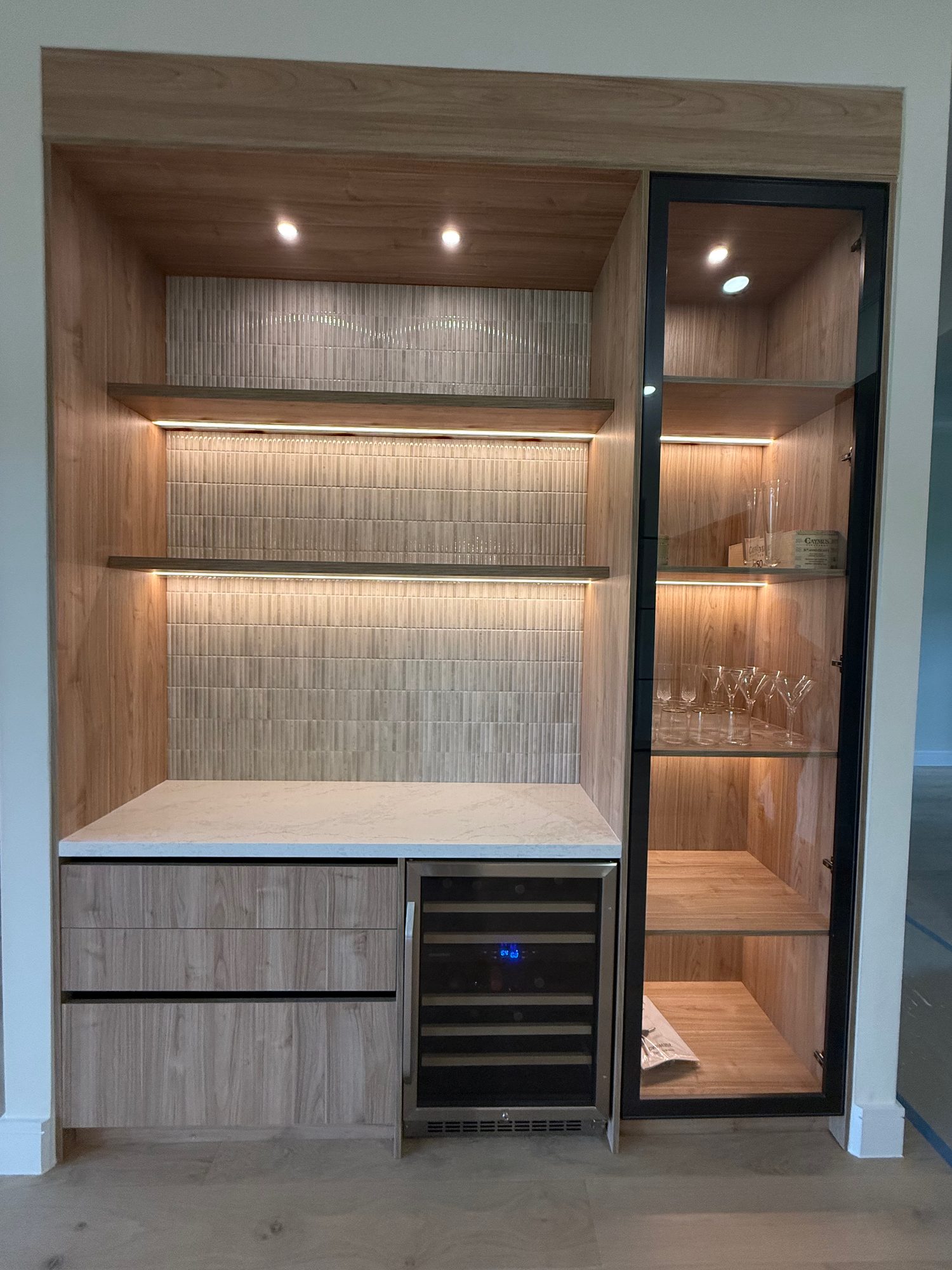
Quartersawn white oak, teak and walnut are reliable choices for interior walls. Teak carries natural oils that resist moisture, and quartersawn oak is prized for dimensional stability. Solid wood is the right material when depth, carved detail or a tactile edge is the point of the design.
VENEER ON A STABLE CORE
Natural veneer over an engineered core moves far less than solid boards, which makes it ideal for wide, flat or large format panels. The key is balanced construction: a backer veneer on the reverse face keeps the panel from cupping. Veneer also allows a single grain sequence to run across a whole wall.
THERMALLY MODIFIED WOOD
Heat treatment in a low oxygen kiln changes the cell structure of species such as ash, lowering how much moisture the wood absorbs. It suits covered terraces and transitional spaces near the water.
A NOTE ON COMPOSITES
Many online answers suggest WPC or PVC panels for humid climates. They resist water but never patina or feel like wood under the hand. Indoors, we prefer real wood specified correctly.
WHAT FINISH PROTECTS WOOD PANELING IN A HUMID CLIMATE?
A finish slows moisture exchange; it does not stop it. The finish should match how the wall will be touched, cleaned and lit.

- Hardwax oil keeps a natural, matte surface and can be refreshed in place, well suited to fluted oak.
- Waterborne lacquer gives a durable, low sheen film for slats near kitchens and bars.
- Seal every face. Backs and edges are finished as carefully as the front, so the panel takes on moisture evenly and stays flat.
- Plan for sun. Strong daylight shifts wood tone over time, so UV resistant finishes and even exposure help a wall age gracefully.
DETAILING AND INSTALLATION THAT KEEP PANELING STABLE
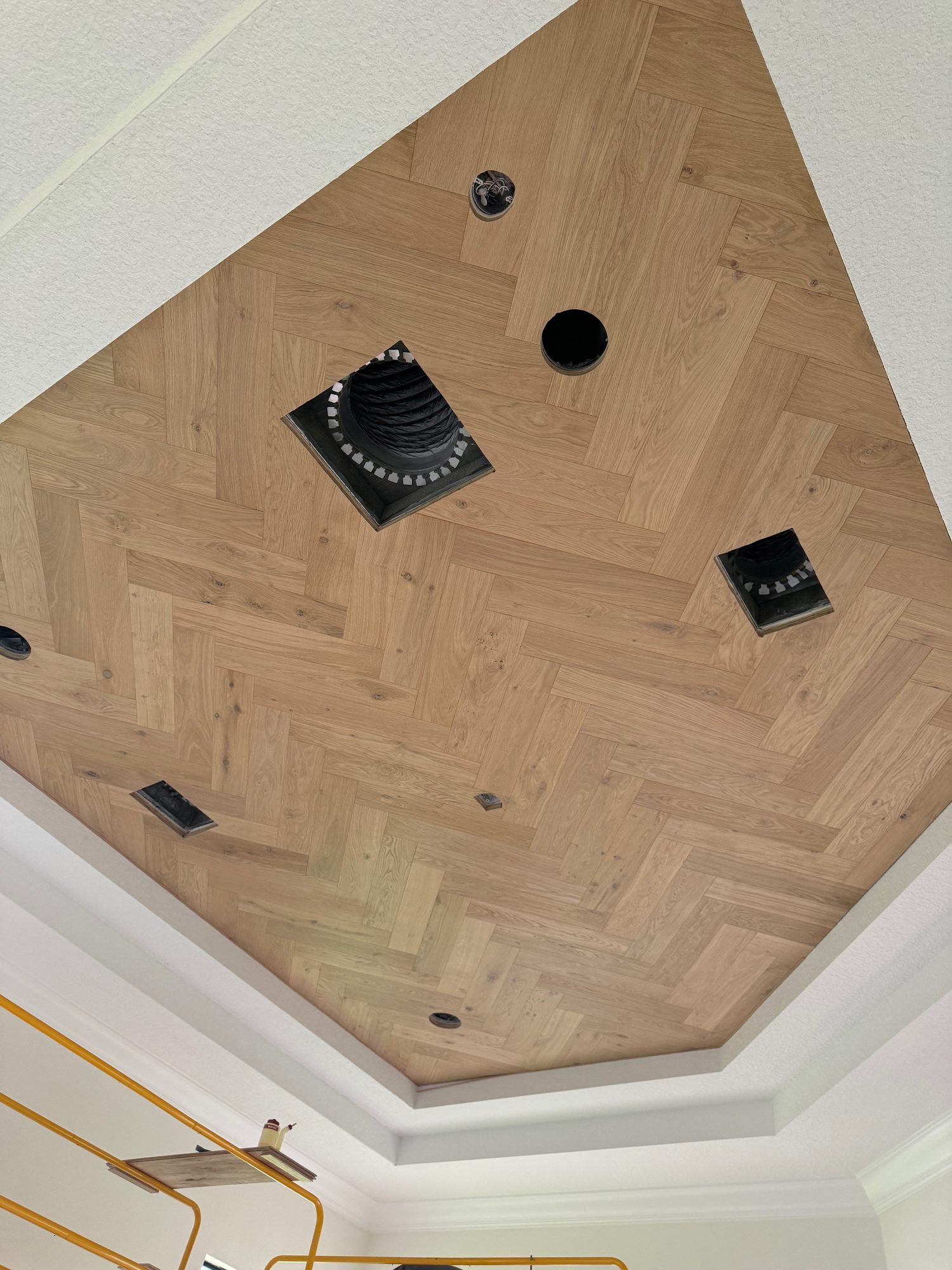
Most failures happen behind the panel, not on its face. Detailing is where a beautiful wall becomes a durable one.
- Acclimate materials in the conditioned room before installation, so the wood meets the wall at the moisture level it will live with.
- Ventilate the back. Many exterior walls in South Florida are concrete block. Mounting panels on battens with an air space, rather than gluing them flat, lets moisture escape and helps prevent mold behind the paneling.
- Leave room to move. Shadow gaps at floors, ceilings and corners are not only aesthetic; they absorb seasonal movement.
- Coordinate the wall. Outlets, thermostats, AC grilles and access panels are drawn into the panel module before fabrication.
Most failures happen behind the panel, not on its face.
On detailing and installation
WALL PANELING IDEAS FOR MIAMI INTERIORS
The best paneled walls solve a problem as well as setting a mood. Ideas we return to often:
- Media walls where slats hide speakers, cables and storage.
- Headboard walls in warm wood that extend onto the ceiling for an enveloping bedroom.
- Entry walls with concealed doors that keep the first view quiet.
- Bars and wine walls with textured back panels and integrated light, as in the Webb Residence.
- Living rooms where a single fluted plane replaces art and frames the view.
For warm walnut millwork as a social spine, see The Delray Residence. For pale wood panels in everyday rooms, see the Renovation in Pinecrest. The Regatta Residence shows millwork from fabrication to finished room.
HOW PAMBUDDHA HOMES DESIGNS A PANELED WALL

Pam and Melissa lead each project together, carrying it through our four services in sequence:
- Project Management. One team holds the schedule, the trades and the decisions.
- Interior Design. Proportion, light and material are resolved with the whole room.
- Millwork Manufacturing. Species, cut, construction and finish are specified and built to the drawings.
- Importation and Installation. Materials arrive, acclimate and are installed with the ventilation and reveals the design requires.
Our work draws on Latin American heritage and organic architecture: ancient and modern, raw yet refined. A paneled wall should feel timeless and light after many Miami summers. Read more about our services, or how custom millwork differs from custom cabinetry.
FREQUENTLY ASKED QUESTIONS
Is wood paneling outdated in 2026?
No. Dated paneling was thin, glossy sheet material. Today’s fluted, slatted and veneered walls use real wood, fine proportions and matte finishes, and they read as architecture rather than trend.
Can mold grow behind wood paneling?
Yes, if moisture is trapped between the panel and the wall. Mounting panels on battens with an air space, sealing every face and keeping indoor humidity below 60 percent greatly reduces the risk.
What are the disadvantages of fluted panels?
Grooves collect dust and need a soft brush to clean, a damaged flute is harder to repair than a single slat, and outlets must be planned into the layout. Good design resolves the last point before fabrication.
What is the difference between fluted and slatted wall panels?
Fluted panels are one continuous surface with milled channels. Slatted walls are separate strips with open gaps over a backing, which gives better sound absorption and more room for each piece to move with humidity.
What is the best wood for paneling in a humid climate like Miami?
Quartersawn white oak, teak and walnut perform well indoors, as does natural veneer over a stable core. Thermally modified wood suits covered outdoor areas. Construction, finish and indoor humidity matter as much as the species.
How much does it cost to panel a room in wood?
It depends on species, construction, wall size, finish and site conditions, so custom paneling is quoted per project. Our guide to interior design cost in Miami explains what shapes an estimate.
Work with the studio
BEGIN WITH A CONVERSATION
If you are considering a fluted or slatted wall, we would be glad to walk you through species, finishes and details in person. Book a consultation with Pam and Melissa, or arrange a visit to our workshop to see and touch the materials before anything is made.