
Millwork and Cabinetry
Custom cabinetry solves storage within defined cabinet zones. Custom millwork can shape the larger architectural language of a room through cabinetry, paneling, doors, ceilings, niches, and integrated details. This guide explains how their scope, documentation, materials, fabrication, and installation differ.
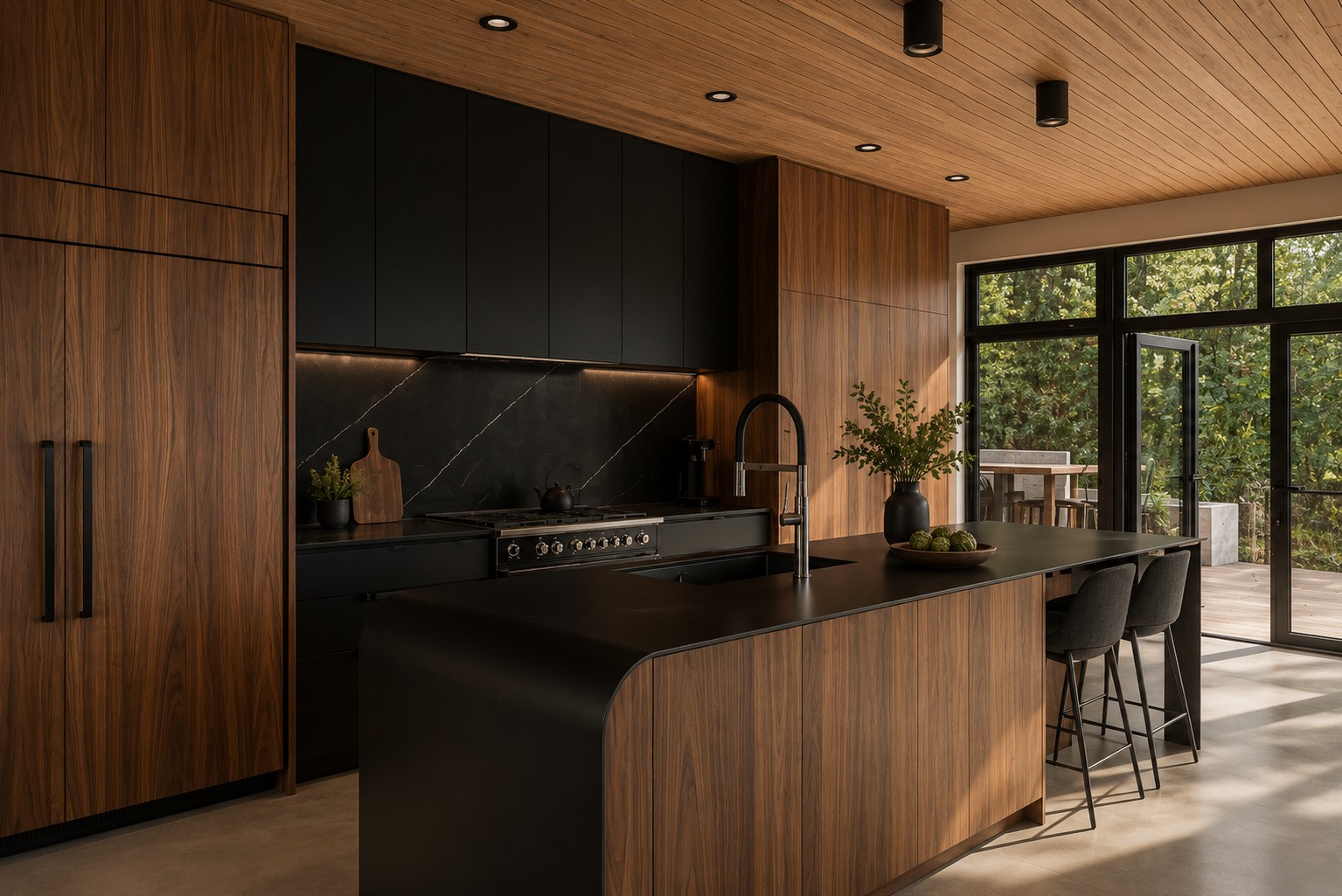
In this article
- Custom Millwork vs. Custom Cabinetry: The Practical Difference
- Materials Are Chosen for Use, Appearance, and Stability
- Grain Matching Turns Separate Parts Into One Composition
- Documentation Protects the Design Before Fabrication
- Fabrication Depends on Approved Information
- Installation Is Where Millwork Meets the Actual Room
- Choose the Scope by Following the Interfaces
- Frequently Asked Questions
The distinction between custom millwork vs custom cabinetry matters when an interior depends on more than well-made storage. Cabinetry typically addresses kitchens, vanities, wardrobes, bars, and other defined cabinet zones. Millwork can include those elements while extending the same material language across wall paneling, doors, ceilings, trims, screens, niches, and built-ins.
Neither term guarantees a higher level of quality. The meaningful difference is scope: what must be designed together, how the parts meet the architecture, and who coordinates the work through installation. Defining that scope early can prevent broken grain lines, conflicting dimensions, and last-minute decisions on site.

For a broader foundation, begin with what custom millwork means in a residential interior. The comparison below focuses on how to choose the right path for a particular project.
CUSTOM MILLWORK VS CUSTOM CABINETRY: THE PRACTICAL DIFFERENCE
Custom cabinetry is designed for a specific location and use. It may include boxes, fronts, shelving, hardware, interior fittings, end panels, and trim. Dimensions respond to the room, appliances, plumbing, storage, and finish.
Custom millwork works at a wider architectural scale. It may connect cabinetry to a paneled passage, conceal a door within a continuous wall, carry wood into a ceiling, or align shelving with stone and lighting. Cabinetry becomes part of a larger composition.
| Consideration | Custom cabinetry | Custom millwork |
|---|---|---|
| Primary role | Organizes storage and function within defined zones | Integrates storage, surfaces, openings, and architectural details |
| Typical elements | Kitchens, vanities, wardrobes, bars, utility cabinets | Cabinetry plus wall panels, doors, ceilings, trims, screens, niches, and built-ins |
| Design focus | Cabinet layout, access, hardware, appliance and fixture clearances | Room-wide alignment, transitions, concealed conditions, rhythm, and material continuity |
| Documentation | Plans, elevations, sections, cabinet details, finish and hardware schedules | Coordinated drawings across cabinetry, walls, ceilings, doors, lighting, stone, and adjoining trades |
| Installation | Often concentrated in cabinet areas | Frequently sequenced across several rooms and construction stages |
| Best fit | A contained cabinet scope with clear boundaries | An interior in which woodwork helps define the architecture |
The choice is not always either-or. A home may need focused cabinetry in one area and integrated millwork elsewhere. The right division depends on visual intent, technical interfaces, and coordination.
MATERIALS ARE CHOSEN FOR USE, APPEARANCE, AND STABILITY
Material selection should begin with the desired surface, daily use, geometry, and site conditions—not with the assumption that one material is universally superior.
Engineered millwork can use stable substrates with natural veneer, melamine, or other engineered finishes. These systems support precise dimensions and clean construction for cabinet boxes, large panels, and detailed assemblies. The exposed finish and substrate serve different purposes, so both should be specified.
Artisan hardwood carpentry follows a different path. Solid wood brings depth, edge character, carving, and tactile variation, but it moves naturally with moisture and temperature. Species, cut, thickness, joinery, finish, and grain direction must be considered as one system.
Many interiors use both paths. Veneered panels can form broad, calm surfaces while solid wood creates edges, frames, pulls, slats, or sculptural details. The decision is not “real” versus “artificial,” but which material suits the scale, performance, touch, and visual intent.
GRAIN MATCHING TURNS SEPARATE PARTS INTO ONE COMPOSITION
Grain is not decoration added after the layout is complete. It affects how the eye reads proportion and continuity. A run of doors can feel like one quiet plane when veneer leaves are sequenced deliberately; the same run can feel fragmented when grain direction changes without purpose.
Several decisions should be resolved before fabrication:
- whether grain runs vertically or horizontally;
- where a sequence begins and ends;
- whether adjacent fronts are book-matched, slip-matched, or intentionally varied;
- how the pattern continues across drawers, appliance panels, fillers, and corners;
- where solid edges interrupt or frame the veneer;
- which natural variations are acceptable within the approved material range.
Mockups and finish samples establish expectations, while elevations and panel maps carry the intention into production. Because matched sequences affect material yield, they should be prioritized where continuity has the greatest spatial effect rather than applied indiscriminately.

DOCUMENTATION PROTECTS THE DESIGN BEFORE FABRICATION
A polished installation begins with information every trade can interpret consistently. Design drawings establish intent; coordinated shop drawings translate it into buildable dimensions, assemblies, clearances, and attachment methods.
Cabinetry documents typically resolve fronts, interiors, hardware, appliance openings, plumbing, toe kicks, scribes, and finished ends. A millwork set may also address ceilings, panel joints, hidden doors, wall build-ups, integrated lighting, stone interfaces, access panels, ventilation, and floor or plaster transitions.
The review must ask what happens at every edge. Can a door clear a light fixture? Can an appliance be serviced? Is there tolerance for an uneven wall? Can an LED driver be reached? Does a shadow gap continue when materials change?
These questions belong before materials are cut. Pambuddha’s integrated interior design, millwork, finishes, and installation services are structured around that relationship between concept and execution.
FABRICATION DEPENDS ON APPROVED INFORMATION
Once drawings, materials, finishes, and hardware are approved, fabrication begins. Work may include material selection, veneer layout, cutting, edge treatment, joinery, machining, dry fitting, sanding, finishing, hardware preparation, and protective packing.
The process should preserve traceability. Panels need clear identification, matched sequences must remain in order, and integrated components must correspond with the drawings. When rooms share a finish, control samples maintain a consistent standard while allowing for natural wood variation.
Not every seam should be hidden or every surface given the most complex detail. Some joints disappear; others form an intentional rhythm. Precision means choosing the required condition, then producing it consistently.
INSTALLATION IS WHERE MILLWORK MEETS THE ACTUAL ROOM
Exact fabrication must still meet real walls, floors, ceilings, stone, appliances, and mechanical systems. Field verification is essential before production dimensions are finalized. Installation planning must account for access, protection, staging, fastening, adjustment, and trade sequence.
Documentation, material control, interfaces, and installation determine how the finished work belongs to the architecture.
On installation
Cabinet installation still depends on level floors, service locations, appliance specifications, and countertop coordination. Architectural millwork has more interfaces: panels may need backing before drywall closes; concealed doors must align with floors and ceilings; lighting requires coordination before panels are fixed; stone templating may depend on installed bases.
In Miami residences, humidity, coastal exposure, condominium access, delivery restrictions, and building approvals may affect material choices or sequencing. Those conditions vary by property and should be confirmed for the specific site rather than treated as universal rules. A Pinecrest renovation perspective may involve different access and construction conditions from a condominium or waterfront residence.
CHOOSE THE SCOPE BY FOLLOWING THE INTERFACES
A cabinetry-focused approach may be appropriate when the work is contained, the architectural surfaces remain largely unchanged, and the cabinet zones can be documented without extensive coordination across rooms.
A broader millwork approach is usually worth considering when:
- cabinetry must align with wall panels, doors, ceilings, or architectural openings;
- grain continuity is central to the room rather than limited to cabinet fronts;
- lighting, stone, metal, plaster, or mechanical systems are integrated into the assembly;
- concealed storage or flush access panels need to disappear within a larger surface;
- the same material language continues across several connected spaces;
- field conditions require detailed transitions rather than standard fillers and trims.
The Pambuddha portfolio shows how cabinetry, paneling, integrated lighting, and natural surfaces can operate as one interior language. The Delray Residence offers another reference for reading material decisions across a complete home. More material-led perspectives are available in the Pambuddha Journal.
Before appointing a studio, ask who owns the interfaces. A cabinetmaker may execute the cabinet package while another party coordinates walls, ceilings, lighting, stone, and finishes. This can work when responsibilities are explicit, but becomes fragile when drawings overlap or site dimensions change. These questions for a luxury interior designer in Miami can help clarify scope, documentation, communication, and installation responsibility.
The companion guide to interior design cost in Miami explains how scope, documentation, materials, fabrication, logistics, and installation shape a project-specific estimate.
FREQUENTLY ASKED QUESTIONS
Is custom millwork better than custom cabinetry?
Not inherently. Custom cabinetry can be the right solution for a defined kitchen, vanity, wardrobe, or bar. Custom millwork becomes relevant when cabinetry must connect to broader architectural elements or when one team needs to coordinate several material and trade interfaces.
Can custom cabinetry use veneer and engineered materials?
Yes. Custom cabinetry may use natural veneer, melamine, engineered finishes, solid wood, or a considered combination. Quality depends on the complete specification: substrate, exposed surface, edge treatment, joinery, hardware, finishing, and installation.
When should grain matching be specified?
Specify it before material allocation and fabrication. The drawings should show grain direction, panel sequence, important transitions, and the treatment of corners, fillers, appliance fronts, and adjacent elements. Samples alone cannot communicate the full layout.
Who should coordinate millwork installation?
Responsibility should be defined in the project scope. The coordinating party needs access to current drawings and site information across design, construction, lighting, stone, appliances, finishes, and installation. Clear ownership matters more than the title of the firm.
Work with the studio
BEGIN WITH THE ROOM, NOT THE LABEL
The best scope follows the interior’s actual needs. If the work is contained, custom cabinetry may provide all the function and refinement required. If woodwork must shape openings, surfaces, light, storage, and transitions together, custom millwork offers the more complete framework.
Pambuddha brings interior design, engineered millwork, artisan hardwood carpentry, finishes, and installation into one coordinated process. To discuss the right level of integration for your home, begin a conversation.


